Cycling Puig Major: Mallorca's Highest Paved Climb
Puig Major is Mallorca's highest paved cycling climb: 14km (8.7 miles) from Sóller to the Monnàber tunnel, gaining 850m (2,789ft) at an average gradient of 6.2%.
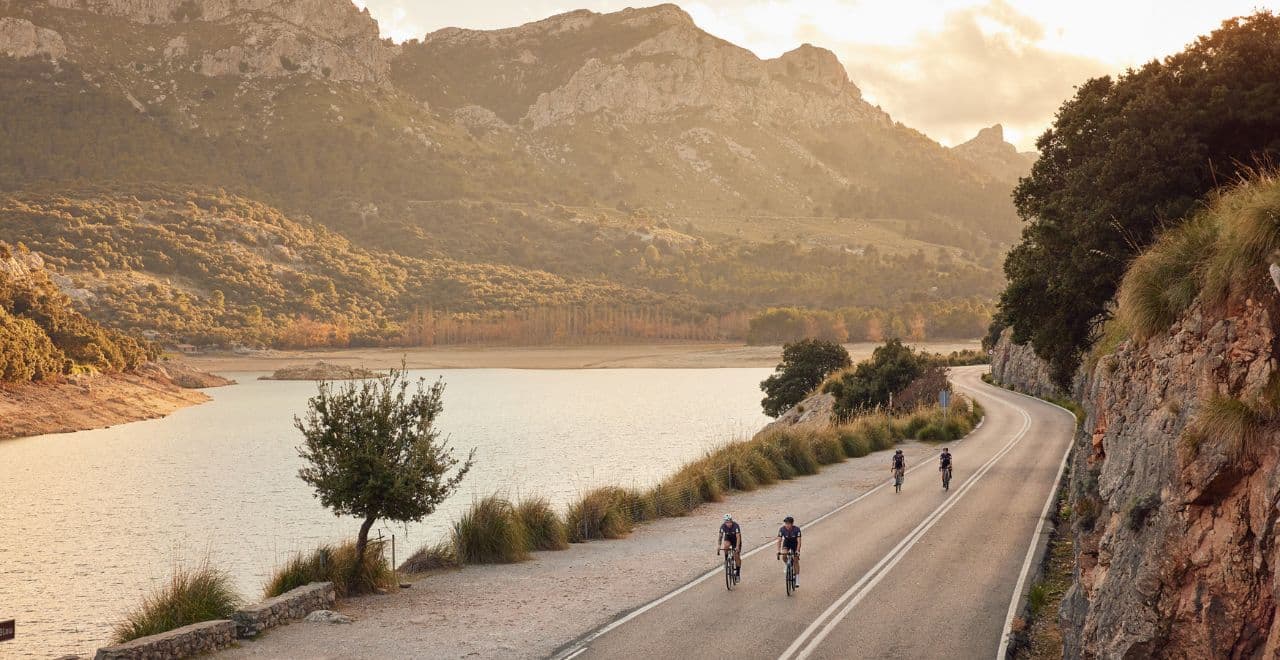
The true summit is off-limits, a restricted military and radar zone, so the road tops out well below it, threading through pine forest and cut-rock hairpins before the reservoirs of Cúber and Gorg Blau open up on the far side.
It's a serious climb for riders who want to test themselves against one of Europe's classic ascents, not a warm-up.
Cycling Puig Major at a Glance
- Puig Major is Mallorca's highest paved cycling climb: 14km (8.7 miles) at an average gradient of 6.2%, gaining 850m (2,789ft) from Sóller to the Monnàber tunnel.
- The true summit is a restricted radar and military zone that cyclists can't reach; the road tops out well below it, not at the actual peak.
- Ride it from the south via Sóller for the classic ascent, or from the north past the Cúber and Gorg Blau reservoirs if you're combining it with Sa Calobra.
- Spring (March to May) and Autumn (September to October) are the best months to ride, when the Tramuntana's cooler mountain air takes the edge off the climbing.
- Love Velo's Road Bike Island Tour rides Puig Major as its own stage on Day 6, descending past the reservoirs to a choice: continue to Sa Calobra or peel off toward the Coll de Femenia.
Puig Major Stats
Below are the numbers that matter before you ride: length, gradient, and where the climb actually starts and finishes.
These are the same headline figures we publish in our Best Cycling in Mallorca guide, where Puig Major sits among Mallorca's best cycling climbs alongside Sa Calobra and Cap de Formentor.
Ride your own GPX file on the day too: a phone or head unit will always read more accurately than any published table.
Make An Enquiry
We are the cycling holiday experts.
Whether you're a keen road cyclist, enjoy riding an e-bike or hybrid bike, or want to get your family more active, we have the perfect cycling holiday for you.
Climbing Puig Major from Sóller
The Route: From Sóller, the climb picks up at the junction of the MA-11 and MA-10, running through pine forest and a run of hairpins toward the Fornalutx turn-off. Around the 6km (3.7-mile) mark, the Mirador ses Barques viewpoint opens onto the Tramuntana ridge before the road tightens again for the steepest ramps between 11km and 12km (6.8 and 7.5 miles), part of roughly 34 hairpins packed into the full ascent.
The final stretch passes a military radar installation before finishing at the Monnàber tunnel. Before you set off, Port de Sóller's harbour is worth the extra half hour: grab a coffee by the water while the old wooden tram trundles along the beachfront, and save the tapas bars for when you're back down.
What you need to know: The lower slopes stay shaded under tree cover for long stretches, but the final few kilometres sit fully exposed, so plan for a real temperature swing between the bottom and the top even on a cool day.
If you're deciding what to ride it on, our road bike hire in Mallorca guide breaks down carbon versus e-road options for exactly this kind of climb.
Rider type: This is a climb for experienced and performance riders who want a genuine test against one of the Tramuntana's classic ascents.
Fitness benchmark: Comfortable riding 14km (8.7 miles) of sustained 6%+ climbing without a break is the baseline. A strong club rider takes 45 to 60 minutes, while a well-trained amateur can be under 40.
Descending to the Reservoirs and the Sa Calobra Decision
Once you're through the Monnàber tunnel, the road drops past the reservoirs of Cúber and Gorg Blau, open and exposed after the shaded climb up. At the bottom, you'll face a choice: continue down to Sa Calobra and climb back up to escape it, or turn off toward Lluc monastery and descend the Coll de Femenia instead.
You can experience this on our road bike tour of Mallorca.
Riding Puig Major from the North
The Route: Starting from Port Pollensa or Alcúdia instead of Sóller, you'll reach Puig Major from the reservoir side, past Cúber and Gorg Blau, before the final push up to the Monnàber tunnel.
You'll pass through Escorca, the small mountain municipality that Puig Major itself sits within, before the road climbs the last stretch to the tunnel. The climbing on this side is shorter than the full Sóller ascent, but it comes after a long ride through the Tramuntana just to reach the base, so the overall day rarely ends up easier.
What you need to know: The reservoir road has far less tree cover than the Sóller side, so you're exposed to wind and full sun for the whole approach, not just the final kilometres. It's also quieter: fewer riders take on Puig Major from this direction, so carry a spare tube and pump, since there's less passing traffic to flag down if you need help.
Rider type: Best suited to experienced and performance riders who are already tackling Sa Calobra or another big Tramuntana day, since this approach is rarely ridden as a stand-alone outing.
Fitness benchmark: Comfortable with sustained climbing over a long day in the saddle. Treat the ride out from Port Pollensa or Alcúdia as part of the effort, not just the final push to the tunnel.
Most riders based in Port Pollensa combine this approach with Sa Calobra, following our Sa Calobra climb guide for the full route, rather than treating Puig Major as a stage on its own.
Either way, expect a long day in the Tramuntana: this isn't a climb you bolt on to the end of an easy ride.
Who Should Ride Puig Major?
Performance and experienced riders
Puig Major is fundamentally a climb for this group. Sustained 6%+ gradient for 14km (8.7 miles), shared traffic, and a tunnel crossing make it a serious undertaking rather than a casual spin, and it rewards riders who've put in the training miles beforehand. Pace it like the long effort it is: settle into a rhythm early rather than burning matches on the lower slopes.
Leisure riders
You can still take this one on. Riding as far as the Mirador ses Barques viewpoint gives you the best of the scenery without committing to the full ascent, and an e-road bike takes the edge off the sustained gradient if you want to reach the tunnel without emptying the tank. Either way, you'll still get the views over the Tramuntana ridge that make this climb worth doing in the first place.
Who Shouldn’t Ride Puig Major?
Family riders
This isn't a climb we'd recommend for family rides. There's no dedicated shoulder on some sections, traffic shares the road with you throughout, and the tunnel isn't suited to younger or less confident riders.
When to Ride Puig Major
Spring and Autumn are the best times to ride Puig Major, when cooler air at altitude takes the sting out of the climbing, but the two seasons ride quite differently on this particular mountain.
Spring (March to May)
Sóller's average daily high climbs from around 15°C (59°F) in March to 21°C (70°F) by May, but the average low stays down near 9 to 12°C (48 to 54°F) into April. Gain another 850m (2,789ft) to the Monnàber tunnel and you'll lose roughly 5 to 6°C (9 to 11°F) more on top of that, going by the standard atmospheric lapse rate, so pack a real layer for the exposed final kilometres even on a warm-looking day lower down.
April is also the busiest month on the island: the Mallorca 312 sportive runs on the last Saturday of the month, with routes of 167km (104 miles), 225km (140 miles), and a full 312km (194-mile) option carrying over 5,000m (16,400ft) of climbing through the Tramuntana. If you're riding independently that week, expect noticeably more cyclists on the roads around Puig Major in the days before the start.
Autumn (September to October)
Daytime temperatures sit close to spring's, with Sóller averaging around 25°C (77°F) in September and cooling to 21.5°C (71°F) by October, but the roads are quieter with no comparable event drawing riders to the island.
October is also the wettest month of the year in the Tramuntana, averaging around 70mm (2.8in) of rain, noticeably more than any spring month, so check the forecast a few days out rather than assuming the shoulder-season sun will hold.
Summer
We wouldn't recommend it. It's rideable if you start early enough to beat the worst of the heat, but Sóller's average high runs 26 to 29°C (79 to 84°F) from June through August, and July is both the hottest stretch and the driest, averaging just 6mm (0.2in) of rain across the whole month.
Heat builds fast on the exposed upper slopes once the sun's properly up, and traffic from cars and motorbikes picks up through the day, so this isn't the window we'd choose to send you up Puig Major if you have the flexibility to ride another time of year.
Winter
This isn’t our preferred time to ride, though it is the quietest season on the mountain. Sóller's average high sits around 12 to 13°C (54 to 55°F) at valley level through December and January, with lows down near 7 to 9°C (45 to 48°F), so expect genuinely cold conditions by the time you reach altitude near the tunnel. If you do go, pack for the cold and check conditions before you set off.
Puig Major vs Sa Calobra: Which Should You Ride?
Sa Calobra is shorter and steeper, all business in under 30 minutes for a strong rider. Puig Major asks for more patience: a longer, more sustained effort at a slightly gentler average gradient, with the reward of a proper mountain pass rather than a dead end by the sea.
Most riders who base themselves in Port Pollensa end up riding both in the same big day, which is exactly what Love Velo's Road Bike Island Tour of Mallorca is built around. If you want the full breakdown of the other climb, our Sa Calobra guide covers the descent, the tie knot, and the climb back out.
Ride Puig Major on a Love Velo Cycling Tour
Puig Major earns its reputation as Mallorca's highest paved climb honestly: a long, sustained pull through the Tramuntana that rewards patience over raw power, whichever direction you ride it from. It's one of the best cycling routes in Mallorca for riders who want a genuine mountain test, not just a scenic spin.
Ready to ride it yourself? Two of our Mallorca cycling tours put Puig Major on the route, so you're not left planning the logistics alone. The Road Bike Island Tour of Mallorca rides it as its own stage on Day 6, descending past the reservoirs toward Sa Calobra, from $1,395.
Prefer to base yourself in one spot instead? The Mallorca Single Based Bike Tour combines it with Sa Calobra, the Coll de Soller and the Coll de Femenia from a single base in Port Pollensa, from $795.
Whichever tour you choose, you'll ride a full carbon road bike on a 105 or Ultegra groupset, with upgrades to DI2 and carbon wheels available if you want to pace the climb without extra weight to carry. Browse the full range of our road cycling tours, or speak to our team about building Puig Major into your own Mallorca itinerary.
Make An Enquiry
We are the cycling holiday experts.
Whether you're a keen road cyclist, enjoy riding an e-bike or hybrid bike, or want to get your family more active, we have the perfect cycling holiday for you.
Frequently Asked Questions